
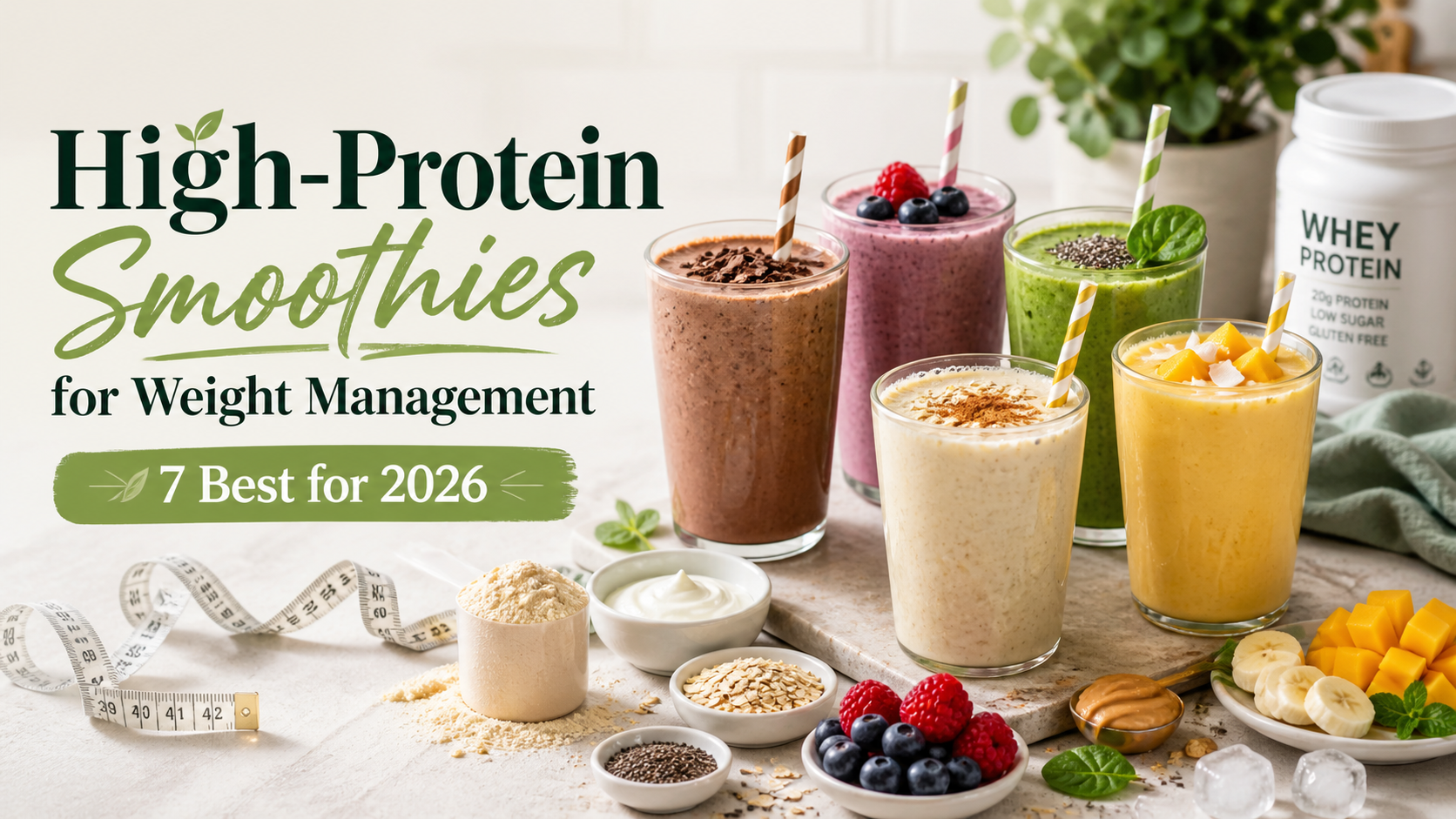
High-Protein Smoothies for Weight Management | 7 Best for 2026

High-Protein Smoothies for Weight Management: 7 Best Recipes in 2026
The best high-protein smoothies for weight management in 2026 use whole food protein sources — Greek yogurt, cottage cheese, hemp seeds, and kefir — rather than relying solely on protein powder. Each of the seven recipes below provides an estimated 14–28 grams of protein per serving. Protein may help you feel fuller, but individual results depend on overall diet quality, activity level, and personal needs.
- Cottage cheese is the breakout protein ingredient of 2026 — half a cup provides approximately 13–14g of protein, making it one of the most efficient whole food choices for high-protein smoothies.
- Greek yogurt remains the most reliable high-protein base for weight management smoothies, delivering approximately 15–17g per ¾ cup when chosen plain and unsweetened.
- Hemp seeds offer a complete plant-based protein (approximately 9–10g per 3 tbsp) and blend seamlessly — a strong choice for dairy-free high-protein smoothies.
- Added sugar is the most overlooked variable in smoothies built for weight management. Always check labels on flavored yogurts, plant-based milks, and protein powders.
- Protein alone is not a weight management strategy — total calorie balance, food variety, sleep, and lifestyle habits all contribute equally.
Why High-Protein Smoothies Can Support Weight Management
If you are looking for high-protein smoothies for weight management, the most important thing to understand is why protein matters in the first place. Adding a meaningful protein source to a smoothie changes its satiety profile significantly: protein is the most filling macronutrient per calorie, and it may help you feel fuller for longer compared to the same calories from carbohydrates or fat alone.
In 2026, the conversation around protein smoothies has shifted away from “add more protein powder” and toward using whole food ingredients — cottage cheese, kefir, hemp seeds, collagen peptides — that provide protein alongside fiber, healthy fats, and micronutrients. This approach typically delivers better texture, simpler ingredient lists, and broader compatibility with different dietary needs.
That said, protein is only one variable. Fiber slows digestion and reinforces fullness. Healthy fats from nut butters or seeds provide sustained energy. Keeping added sugar low ensures your smoothie is working with your goals, not against them. Every recipe in this guide is designed with all of those factors considered together.
How We Selected These 7 High-Protein Smoothie Recipes
- Protein content: Each recipe targets approximately 14g or more per serving using whole food sources first.
- Weight management suitability: Designed to support satiety without excessive added sugar or unnecessary calorie density.
- Added sugar: Recipes prioritize naturally sweet ingredients and avoid flavored or pre-sweetened bases.
- Ingredient simplicity: All ingredients are widely available in US grocery stores at accessible price points.
- Trend relevance: Reflects the most-searched protein ingredients and smoothie patterns of 2025–2026.
- Dietary variation: Seven options covering dairy-based, plant-based, gut health-focused, and energy-focused choices.
- Label transparency: Where exact values depend on brand, we note specifically where to verify the nutrition label.
These are editorial recipe suggestions based on publicly available USDA FoodData Central nutrition data. Exact protein and calorie values vary by brand and serving size. Always verify with your specific ingredient labels before calculating daily intake targets.
7 Best High-Protein Smoothie Recipes for Weight Management in 2026
Cottage Cheese Strawberry High-Protein Smoothie
This high-protein smoothie for weight management became one of the most shared recipes on TikTok and Instagram starting in 2023 — and it holds up. Half a cup of low-fat cottage cheese provides approximately 13–14g of protein, a neutral flavor that disappears behind fruit, and a creamy texture that rivals commercial protein powders. If you have never tried cottage cheese in a smoothie, this is the most accessible starting point.
- ½ cup low-fat cottage cheese (plain)
- 1 cup frozen strawberries
- ½ medium banana
- ¾ cup unsweetened almond milk (or dairy milk for more protein)
- ½ tsp vanilla extract
- 1 tsp honey (optional)
- Add all ingredients to a blender. Blend on high for 45–60 seconds until completely smooth.
- Taste and adjust sweetness with honey if needed. Serve immediately.
Optional add-ins: 1 tbsp chia seeds (fiber + omega-3s); 1 tbsp hemp seeds (+~3g protein). Protein values vary by brand — always check your cottage cheese label.
Spinach Banana Greek Yogurt Protein Smoothie
Greek yogurt is still the most dependable base for high-protein smoothies built around weight management goals. Plain, non-fat Greek yogurt delivers approximately 15–17g of protein per ¾ cup — one of the highest concentrations in any accessible dairy food. Baby spinach adds iron, folate, and magnesium without changing the flavor meaningfully.
- ¾ cup plain, non-fat Greek yogurt
- 1 cup baby spinach (packed)
- 1 medium banana (frozen for best texture)
- 1 tbsp almond butter (no added sugar or salt)
- ¾ cup unsweetened almond milk or oat milk
- Pinch of cinnamon
- Add spinach and liquid to the blender first. Blend briefly to break down the greens.
- Add remaining ingredients and blend on high for 45–60 seconds until smooth.
Always use plain, unsweetened Greek yogurt — flavored varieties typically contain 10–20g or more of added sugar per serving.
Chocolate Peanut Butter Protein Smoothie for Weight Management
Among all high-protein smoothies for weight management in this guide, this one delivers the highest estimated protein total without any protein powder — when using unsweetened dairy milk as the base. Unsweetened cocoa powder adds full chocolate flavor without the sugar load of flavored powders or syrups.
- ½ cup plain Greek yogurt
- 2 tbsp natural peanut butter (no added sugar, salt, or palm oil)
- 1 frozen banana
- 1 tbsp unsweetened cocoa powder
- 1 cup unsweetened dairy milk
- Ice cubes, as needed
- Optional: 1 scoop protein powder (check label)
- Combine all ingredients in a blender. Blend on high for 60 seconds.
- Adjust thickness with more milk or ice. Blend again and serve.
Substituting plant milk for dairy milk reduces total protein by approximately 5–6g. If adding protein powder, verify the full ingredient list and allergen disclosures on that product’s label.
Mango Ginger Collagen Protein Smoothie
Collagen peptide powders have become a mainstream addition to high-protein smoothies, particularly for readers interested in skin, joint, and connective tissue support alongside their weight management goals. They dissolve fully in blended drinks, add no detectable flavor, and pair naturally with tropical fruits.
- 1 cup frozen mango chunks
- ½ cup plain Greek yogurt (or unsweetened coconut yogurt for dairy-free)
- 1 scoop collagen peptides (check your product label for protein content and source)
- 1 tsp fresh grated ginger (or ¼ tsp ground ginger)
- ¾ cup unsweetened coconut water
- Juice of ½ lime
- 1 tsp honey (optional)
- Add all ingredients to a blender. Blend until smooth, approximately 45 seconds.
- Taste and add honey if needed. Serve chilled.
Collagen protein content varies significantly — some provide 8g per scoop, others 18g+. Always check your specific product label. If using dairy-free coconut yogurt, verify that product’s added sugar and protein content separately.
Grass-fed, pasture-raised bovine collagen. Dissolves completely in cold liquids. Whole30 Approved, Paleo Friendly, 0g sugar. Approx. 18–20g protein per serving — verify the label.
Banana Oat Chia Breakfast Smoothie
For readers who want both protein and sustained energy, this breakfast smoothie for weight management is the most complete meal-style option in this guide. Rolled oats provide complex carbohydrates and beta-glucan fiber. Chia seeds contribute omega-3 fatty acids, additional fiber, and a modest protein boost.
- ½ cup rolled oats (old-fashioned, not instant)
- 1 ripe banana (fresh or frozen)
- 2 tbsp chia seeds
- ½ cup plain Greek yogurt
- 1 cup unsweetened almond milk or dairy milk
- ½ tsp cinnamon
- 1 tsp maple syrup (optional)
- Soak chia seeds in the almond milk for 3–5 minutes before blending to avoid a gritty texture.
- Add all ingredients to the blender and blend on high for 60–75 seconds until fully smooth.
Using dairy milk instead of almond milk adds approximately 8g more protein per cup. This smoothie is intentionally thicker than most — adjust liquid to your preferred consistency.
Look for USDA Organic, Non-GMO chia seeds. Approx. 5g fiber and 2–3g protein per tablespoon. Navitas Organics and Viva Naturals are well-reviewed options on Amazon.
Vanilla Hemp Seed Kefir Protein Smoothie
This high-protein smoothie is uniquely suited for readers pursuing gut health support alongside weight management goals. Plain kefir provides approximately 9–11g of protein per cup along with live probiotic cultures. Hemp seeds add a complete plant protein containing all nine essential amino acids, plus omega-3 and omega-6 fatty acids.
- 1 cup plain, unsweetened kefir (whole-milk or low-fat)
- 3 tbsp hulled hemp seeds
- 1 frozen banana
- ½ cup frozen mango chunks
- 1 tsp vanilla extract
- Optional: 1 large handful baby spinach
- If adding spinach, blend kefir and spinach first until fully smooth before adding other ingredients.
- Add remaining ingredients and blend on high for 45 seconds. Serve immediately.
Kefir protein values differ by brand and fat percentage — check your specific label. Hulled hemp seeds blend completely smooth and have a mild, slightly nutty flavor.
Amazon’s #1 best-selling hemp seeds. Approximately 10g complete plant protein and 12g omega-3 & 6 per 30g serving, per the product label. Non-GMO, Vegan, Gluten-Free, Keto & Paleo friendly.
Matcha Cashew High-Protein Morning Smoothie
Matcha contains a moderate amount of caffeine alongside L-theanine, an amino acid associated with calm, focused alertness compared to coffee alone. This high-protein smoothie pairs that energy profile with the creaminess of cashew butter and the substantial protein density of Greek yogurt. It is the most café-quality option in this guide for weight management smoothies.
- 1 tsp culinary or ceremonial grade matcha powder
- ¾ cup plain Greek yogurt
- 2 tbsp cashew butter (no added salt or sugar)
- 1 frozen banana
- 1 cup unsweetened oat milk
- 1 tsp honey (optional)
- 3–4 ice cubes
- Whisk matcha powder with 2 tbsp of warm — not boiling — water in a small bowl until fully dissolved with no lumps.
- Add all ingredients including dissolved matcha to the blender. Blend on high for 60 seconds. Serve cold.
Pre-dissolving matcha prevents clumping. Switching to dairy milk adds roughly 5–6g more protein. Cashew butter protein content varies by brand — check your label.
Amazon’s #1 best-selling matcha. USDA Organic, shade-grown and stone-milled in Japan. Culinary grade — versatile for smoothies, lattes, and baking. No additives, no sweeteners.
Protein Source Comparison: What to Use in High-Protein Smoothies
Use this table to mix, match, and substitute ingredients based on your dietary needs and weight management goals. All values are approximate ranges from USDA FoodData Central public data. Actual values vary by brand — always verify with your specific product’s nutrition label.
| Protein Source | Serving | Est. Protein | Dairy-Free | Added Sugar Risk | Notes |
|---|---|---|---|---|---|
| Cottage Cheese (low-fat, plain) | ½ cup | ~13–14g | ✗ | Low (plain only) | Best viral pick of 2026; check sodium |
| Greek Yogurt (plain, non-fat) | ¾ cup | ~15–17g | ✗ | Low if plain | Flavored versions: 10–20g added sugar |
| Kefir (plain, low-fat) | 1 cup | ~9–11g | ✗ | Low if plain | Adds live probiotic cultures |
| Hemp Seeds (hulled) | 3 tbsp | ~9–10g | ✓ | None | Complete amino acid profile; plant-based |
| Collagen Peptides (unflavored) | 1 scoop | Varies — check label | ✓* | None (unflavored) | *Not vegan; bovine or marine source |
| Peanut Butter (natural) | 2 tbsp | ~8g | ✓ | Low (natural variety) | Also adds healthy fats; measure carefully |
| Almond Butter (natural, unsweetened) | 2 tbsp | ~6–7g | ✓ | Low (unsweetened) | Higher in vitamin E |
| Cashew Butter (natural) | 2 tbsp | ~5g | ✓ | Low (natural variety) | Creamiest texture; lower protein than PB |
| Dairy Milk (whole or low-fat) | 1 cup | ~8g | ✗ | Low (plain) | Best protein-adding liquid base |
| Oat Milk (unsweetened) | 1 cup | ~2–3g | ✓ | Check label — varies by brand | Some brands add significant sugar; verify |
| Unsweetened Almond Milk | 1 cup | ~1g | ✓ | Low (unsweetened) | Low-calorie base; minimal protein |
| Protein Powder | 1 scoop | Varies — check label | Brand-dependent | Check label — varies widely | Wide quality range; read full ingredient list |
Source: General ranges based on USDA FoodData Central publicly available data. Always verify with your specific product’s Nutrition Facts label before calculating daily intake.
5 Common Mistakes That Undermine High-Protein Smoothies
5 Pro Tips for Better High-Protein Smoothies
A compact 900W blender widely used for daily smoothies. Handles frozen fruit, Greek yogurt, hemp seeds, and oats consistently. BPA-free cups are dishwasher-safe. A dependable starting point for a daily smoothie habit without a large footprint on the counter.
Grass-fed bovine collagen. Dissolves in cold liquids. 0g sugar. Whole30 & Paleo certified. Check label for exact protein per scoop.
View on Amazon →Amazon’s #1 hemp seeds. ~10g complete protein & 12g omegas per 30g serving (per label). Non-GMO, Vegan, Gluten-Free.
View on Amazon →Amazon’s #1 best-selling matcha. USDA Organic, stone-milled in Japan. Great for smoothies and lattes. No additives or sweeteners.
View on Amazon →~5g fiber and ~2–3g protein per tablespoon. Look for Non-GMO, organic options. Navitas Organics and Viva Naturals are well-reviewed.
Browse on Amazon →Compact 900W smoothie blender. Handles frozen fruit, seeds, and Greek yogurt. BPA-free cups, dishwasher-safe. Most smoothies done in under 60 seconds.
View on Amazon →Disclosure: Links above are Amazon affiliate links. Dareum Company earns a small commission from qualifying purchases at no extra cost to you.
Which High-Protein Smoothie Is Right for Your Weight Management Goals?
- Want to try the viral trend without protein powder? → Cottage Cheese Strawberry Smoothie — the top high-protein smoothie trending in 2026.
- Need the most proven, reliable high-protein option? → Spinach Greek Yogurt Smoothie — the established benchmark.
- Want maximum satiety with a dessert-like flavor? → Chocolate Peanut Butter Smoothie — highest estimated protein total when using dairy milk.
- Interested in collagen or prefer lighter tropical flavors? → Mango Ginger Collagen Smoothie + Vital Proteins on Amazon ↗
- Want fiber and protein together for a complete breakfast? → Banana Oat Chia Smoothie — most filling meal-style option in this guide.
- Prioritizing gut health alongside high-protein intake? → Vanilla Hemp Seed Kefir Smoothie + Manitoba Harvest Hemp Hearts ↗
- Want a coffee alternative with substantial protein? → Matcha Cashew Morning Smoothie + Jade Leaf Matcha ↗
The best high-protein smoothie for weight management is the one you will actually make consistently. Adjust portions and ingredients based on your circumstances, and consult a registered dietitian if you have specific health or nutrition targets.
Frequently Asked Questions About High-Protein Smoothies for Weight Management
A smoothie is generally considered high-protein when it provides 20 grams or more of protein per serving. Smoothies with 15–20 grams can still meaningfully contribute to daily protein intake. The appropriate target varies by body weight, activity level, and total daily protein goals. Consult a qualified nutrition professional for guidance tailored to your situation.
Higher-protein foods and drinks may help you feel fuller for longer, which can support a calorie-conscious eating pattern as part of a balanced overall diet. However, smoothies alone are not a guaranteed strategy for weight loss. Overall diet quality, total calorie balance, sleep, stress management, and physical activity all play important and interconnected roles in body weight.
Cottage cheese can be a practical protein source for smoothies. Half a cup of low-fat plain cottage cheese typically provides around 13–14 grams of protein depending on the brand, along with calcium and phosphorus. The texture blends completely smoothly when combined with fruit, and the flavor is mild enough that most people cannot detect it. Always check your specific brand’s nutrition label for exact values.
Unsweetened dairy milk contributes approximately 8 grams of protein per cup, making it the highest-protein liquid base option. Plain kefir adds both protein — approximately 9–11 grams per cup — and live probiotic cultures. Unsweetened oat milk provides about 2–3 grams per cup, while unsweetened almond milk contributes very little protein on its own. Always check the Nutrition Facts label for added sugars, as these vary significantly between brands.
A well-planned smoothie can work as a meal-style option when it includes a thoughtful combination of protein, healthy fats, fiber, and sufficient total calories for the meal it is replacing. However, not every smoothie is nutritionally complete enough to consistently replace a full meal. If you plan to use smoothies regularly in place of meals, working with a registered dietitian is the most reliable approach.
Want More High-Protein Smoothie Guides?
Get our weekly wellness food guides — practical, clearly sourced, and actually useful. No spam, no fads.
Join the Newsletter →
